

While EVM is often misunderstood as an accounting tool or a compliance requirement. In reality, EVM is fundamentally a sensor system — a way of observing the project’s actual state. It measures progress, cost, and time, and compares them to expectations. These signals are noisy, imperfect, and incomplete, but they are essential. In control‑theory terms, EVM provides the feedback.
But feedback alone does not control anything. It is like having a thermostat that only measures temperature, but never adjusts the furnace. Likewise, EVM without a predictive model is an open‑loop system: it tells you where you are, but not where you’re going.
The real power of EVM emerges when it becomes part of a closed‑loop control process:
- Actuals reveal realized productivity — the true velocity of the project
- Variances highlight deviations — cost and schedule signals that something has changed
- Forecasts update expected outcomes — projecting future performance
- Decisions adjust inputs — staffing, sequencing, scope, spending rate
However, EVM alone cannot answer the most important question in project control:
What is the probability that the project will meet its objectives and deliver value?
To answer this question, requires accounting for the uncertainty that will effect the future progress of the project, not just measuring current performance.
This is where probabilistic risk analysis closes the loop. Monte Carlo simulation transforms uncertainty from a vague concern into a quantifiable input into the decision making process. It allows the project team to:
- Forecast cost and schedule outcomes probabilistically
- Quantify the likelihood of meeting value thresholds
- Identify the drivers of variance
- Evaluate alternative plans through what‑if scenarios
- Update forecasts dynamically as new EVM data arrives
Here is an example of a Tracking or EV chart that combines EVM and Monte Carlo analysis. In this example, the project schedule put higher risk system integration work at the end of the project and this is indicated by the wide range of possible outcomes.
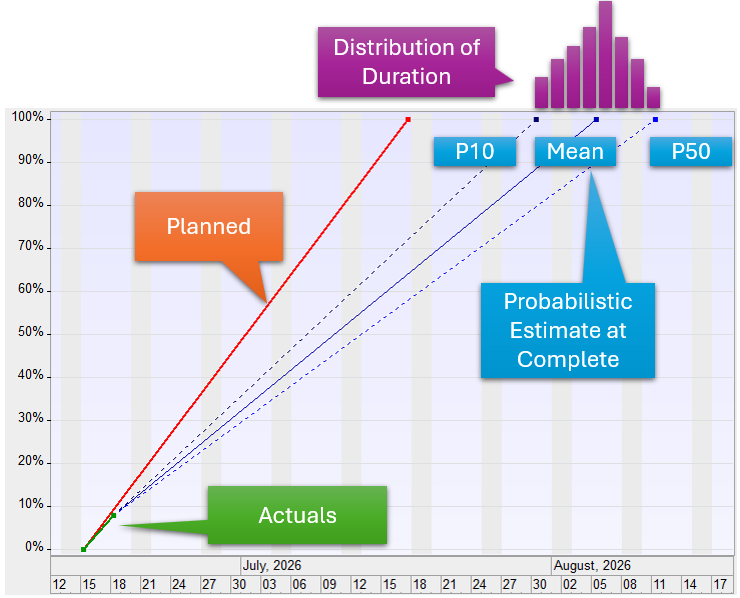
From this we can state that Together, EVM and risk analysis are the foundation of a true control system.
This integration also resolves a long‑standing flaw in traditional project management: the management of cost, schedule, and scope. When these parameters are treated as independent objectives, decision‑making becomes adversarial and fragmented. But when they are treated as parameters of a single value function, the entire organization aligns around a common goal.
The project manager becomes the controller, adjusting inputs to maximize value under uncertainty. EVM provides the measurements. Risk analysis provides the predictive engine. Together, they create a Risk Based Project Control that continuously optimizes value over the life of the project.