

Project Control’s underlying principles are based on Control Theory originally developed for engineering systems where the current state is continuously measured, deviations noted, and corrections made to minimize deviation. It can be described as a forward feed, close loop control system. In such systems, the goal is not to follow a rigid deterministic plan, but to continuously monitor, compare with plans, and adjust accordingly.
A great analogy that one of my colleagues uses is this paradigm is analogous to the difference between a ballistic and a cruise missile. The former is very deterministic in that once it is launched it follows a well-defined path with little ability to change course. On the other hand, cruise missile accuracy is not due to a perfect initial plan; their incredible accuracy is due to constant measurement of its current state that is compared to its original plan, deviations are assessed, and results in continuous course corrections.
If this sounds familiar, it should as it is the foundation of Earned Value Management (EVM) which is a key aspect of project control. EVM is provides the projects situational awareness and calculates deviations from the original plan. The measurements based on percent complete of tasks on calendar date (Status Date). Deviations for both cost and schedule are commonly calculated as variances using planned values for work completed vs actual costs spent or planned cost of work completed vs planned cost of work. The former generates a cost performance index (CPI) the latter the Schedule Performance Index (SPI). These measurements are also used to predict the final cost and schedule values Estimate at Completion (EAC) and other forecasts.
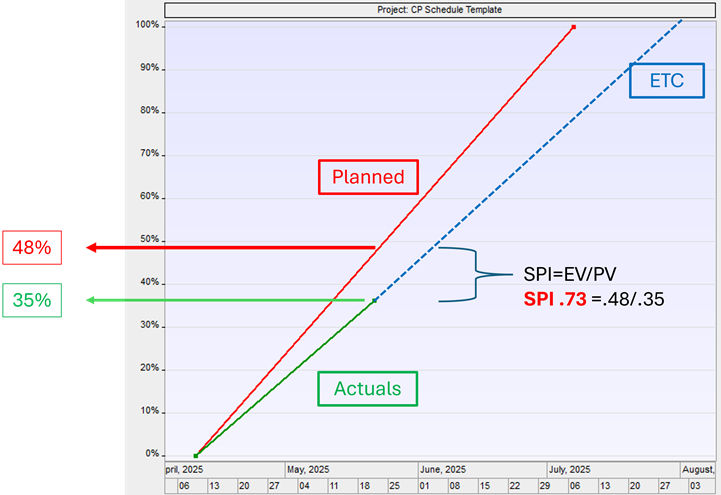
One of the known issues with this system is the deterministic estimates upon which the performance measurements and observed deviations are based on. The EAC ignores the evidence of the measured variance that is a clue that the project outcomes are not deterministic, but probabilistic and subject not only the inherent uncertainty in factors such as quality and productivity, but risk events that can dramatically change the status of a project. The estimates generated from EVM include many assumptions: static productivity rates, levels of risk are unchanged and others. To improve these estimates requires quantitative risk analysis that accounts for risk and uncertainty and with more advanced analysis techniques can use observed changes in product velocity and incorporated into probabilistic forecasts.