

Project schedules can be consolidated and replaced with an “equivalent” schedule that has fewer tasks but is still sufficiently accurate for portfolio-level analysis. This improves the performance of Monte Carlo risk analysis for large portfolios and, more importantly, provides more accurate risk analysis results because it allows analysts to focus on a limited number of the most important tasks and assign risks to them. Here is how to do it in practice.
How to Apply Schedule Condensation
Many projects feature repeatable segments—e.g., similar phases across multiple sites, identical battalion movements in historical campaigns, or standardized subprocesses in a portfolio. Steps to condense:
- Identify groups of tasks with a single-entry point (limited predecessors), no hard constraints (e.g., “Must Start On” dates), and shared risks/costs/durations.
- Isolate the group and run a separate Monte Carlo simulation to generate statistical distributions for its total duration and cost.
- Create discrete or custom probability distributions from the results (separate for duration and cost if needed).
- Replace the entire group in the portfolio schedule with a single “equivalent” task using these distributions.
This drastically reduces the number of tasks in critical path calculations, speeding up portfolio simulations while maintaining accuracy. Bonus: After running the full portfolio simulation, you can “drill down” into the condensed group to view detailed distributions for individual tasks.
Using Condensation techniques in RiskyProject
If you’re looking to put schedule condensation into action, RiskyProject offers built-in tools that directly support these techniques for faster Monte Carlo simulations on large projects and portfolios.
Schedule Consolidation
RiskyProject’s Schedule Consolidation feature automatically simplifies large complex schedules to boost Monte Carlo performance. It generates an equivalent schedule that maintains the same overall duration and cost by:
- Consolidating sequential tasks
- Removing redundant summary tasks
- Applying other optimizations to reduce the number of activities
This creates a condensed model ideal for quick portfolio-level risk analysis without losing key statistical outcomes.
Subprojects (Summary/Master Projects)
For repeatable or modular groups, RiskyProject supports subprojects in portfolio analysis. You can:
- Run Monte Carlo simulations on individual subprojects or detailed groups separately.
- Insert the resulting statistical distributions (for duration and cost) as single tasks into a higher-level summary or master project.
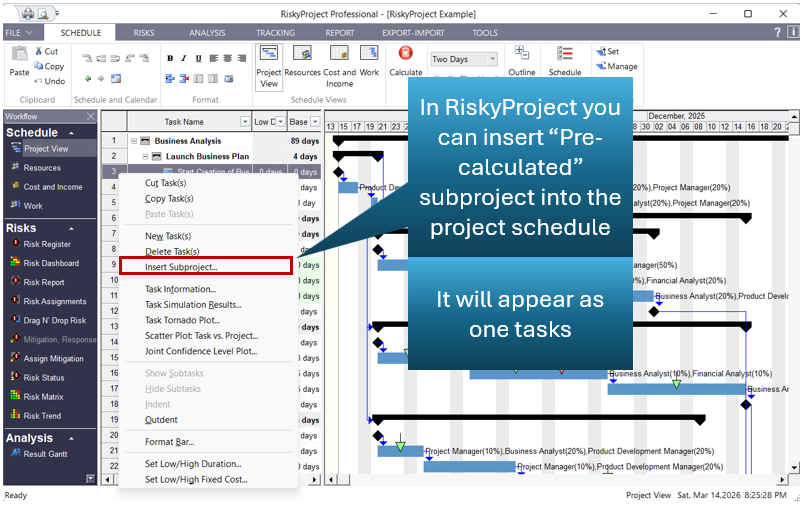 This mirrors the condensation process—replacing complex segments with equivalent probabilistic tasks—while allowing drill-down into details when needed. It’s particularly powerful for mixed execution/planning portfolios or programs with repeated elements.