

Running Monte Carlo risk analysis on a large portfolio of projects can be computationally intensive due to the sheer number of tasks involved. One effective solution is to simplify individual project schedules while preserving key elements like start/finish dates, costs, dependencies, and uncertainties. This creates an “equivalent” schedule with fewer tasks that’s still accurate enough for portfolio-level analysis. Striking the right balance—enough detail to capture risks without overwhelming complexity—is key. Here are practical approaches to achieve this.
Simplifying Using Schedule Hierarchy (WBS Levels)
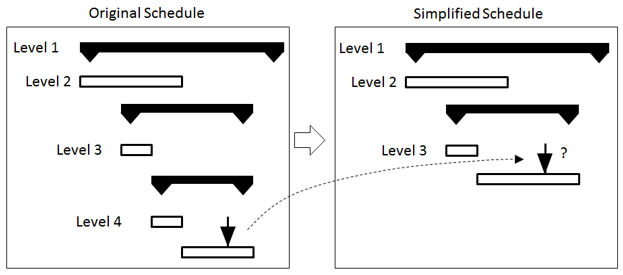
A common simplification is to run simulations only on higher-level tasks (e.g., levels 1–3), rolling up costs, resources, and uncertainties from lower-level activities (e.g., level 4) to their summaries. This reduces model size but has limitations:
- Risks tied to specific low-level tasks may not map perfectly to summaries.
- Resource allocations or cost distributions can become less accurate when aggregated.
As a result, the simplified model might not fully equate to the detailed original, potentially under- or over-estimating certain risks.
Schedule “Condensation”: Borrowing from Structural Engineering
A more sophisticated technique, inspired by model order reduction in mathematics and engineering, is known as “static condensation” in finite element analysis. In structural engineering, complex models (like truss structures) are simplified by calculating internal behaviors separately and replacing them with equivalent “super-elements” that preserve overall stiffness and response.
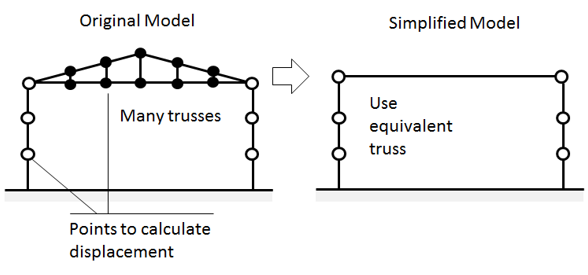
This idea translates directly to project schedules, especially for repeated or modular groups of tasks. A project schedule can be condensed so that a single task represents multiple tasks in the original schedule. The start and finish times, cost, and duration of this single task will be the same as the start and finish times, cost, and duration of the original group of tasks. The work, assigned risks, and other properties of the condensed task will match those of the original tasks. Intermediate tasks within the group should not have links (predecessors or successors) outside the group. As a result, not all groups of tasks can be condensed. However, in real-life project schedules, there is a sufficient number of tasks that can potentially be condensed, significantly simplifying the overall schedule.