

As discussed in previous post on Risk Based Project Control, EVM provides project teams the situational awareness and Monte Carlo simulation turns uncertainty into actionable intelligence by treating durations, costs, productivity, and risk events. But the real leap forward comes when Monte Carlo is combined with Bayesian predictive learning which solves one last issue that persists in the practice of Monte Carlo simulations: how combine information from project control and original project estimates. Essentially the question is what probability distributions should be used to model uncertainties.
To forecast a project’s duration, completion date, and cost, you can use two sources of information:
- The original estimates, which should be based on previous similar projects.
- The actual performance of the current project.
If you use only the original estimates, the forecast may not be accurate because the current project may not perform in the same way as previous projects. At the same time, if you use only the actual project performance, you will essentially ignore the historical information from similar projects. Bayesian analysis provides a solution by generating probability distributions for Monte Carlo risk analysis that integrate both the original estimates and actual project performance data, which are referred to as observations.
In traditional Monte Carlo the distributions that are used in the modelling are static, that is they are not updated to reflect the velocity or rate at which the project is progressing. Traditional forecasting assumes that initial distributions are a relatively accurate model of expected uncertainties and normally remain unchanged during the project lifecycle. That is, if triangular distributions are originally used to model uncertainty, they remain triangular regardless of what the actuals from project control suggest. Bayesian Predictive Learning resolves this issue by using observed performance to dynamically generate distributions that reflect the true velocity of the project.
Bayesian learning leverages every new piece of EVM data — percent complete, cost incurred, realized productivity — as the basis to update the probability distributions of future outcomes. This is Bayesian updating in action:
-
- If risks materialize, the distribution used in the simulations widens
- If velocity improves such as in cases where significant learning has taken place, the distribution used in the simulations narrow.
The combination of EVM performance data, Monte Carlo simulation and Bayesian methods creates a digital twin of the project that learns. Monte Carlo simulation propagates these updated distributions forward, generating probabilistic forecasts for cost, and schedule that reflect the actual changes in the velocity of the project – how likely is it to meet the project’s value objectives.
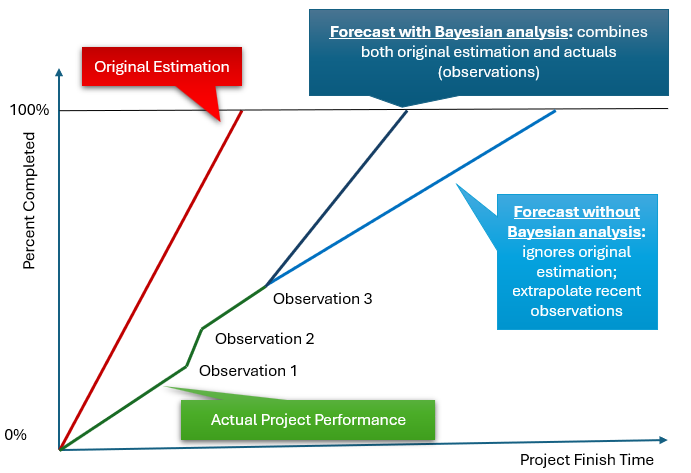
Bayesian Monte Carlo shows how those inputs influence the probability distribution of value. It allows the PM to run what‑if scenarios, evaluate trade‑offs, and choose the actions that maximize expected value. This is real control theory applied to projects: measure → update → predict → decide → act → measure again. It is adaptive, data‑driven, and grounded in reality.
This approach also resolves the limitations of traditional EVM forecasting where forecasts assume that past performance will continue unchanged. Bayesian predictive learning recognizes that performance evolves and that uncertainty is dynamic. The result is forecasts that are more realistic and more aligned with how real projects behave.
With our latest release includes an optional module – RiskyProject Special Edition, which integrates Bayesian Predictive Learning seamlessly into our Monte Carlo simulation engine and can provide true Risk Based Project Control for your high risk, high uncertainty projects.
See also:
Why Earned Value Is Only Half the Control Loop
Rethinking Project Control: From Deterministic to Probabilistic